On 7 August 2026 the Owner formally asked iEnergia to pursue a warranty claim against Arctech for the bearing failure, having independently concluded that the side-rivet remedy "is not an adequate solution". This page holds the claim, the engineering that supports it, and the field evidence: the blocked bearing photographed (11 & 17 Aug) and the resulting noise measured (17 Aug). The claim email and the 6-page technical report (Rev. 05) are drafted and ready — nothing has been sent.
Scope & tone — Rev. 05 (21 Aug): tracker only · diagnosis, not verdict
By instruction, the claim is now framed exclusively as a tracker operating problem: bearing blocked → binding → stick-slip noise and jerky movement → wind-stow reliability, drive-train overload, structural fatigue at the rivet penetrations, accelerated wear, tracking accuracy and production. All module-damage content has been removed from the report and the email — that matter is the Owner's claim against the module manufacturer and stays out of our lane. The internal analysis linking the two remains on the Bearing Timeline page and is not part of any outbound document. Rev. 04 softening (Emilio's instructions): the mechanism is presented as our working diagnosis, explicitly not a conclusion — root cause is for Arctech's investigation; thermal movement is offered as one hypothesis, not fixed as the cause; no deadlines on the requests; wind-stow, part-number and motor-current items removed; the manual's degree tolerances added (±12° bearing self-alignment, ±3° clocking, posts ±2°/±1° — generous on angles, only ±1.5 mm axially); Los Sauces II noted as retaining the earlier bearing version, not retrofitted (now request #7); and all Owner-attributed content removed (Thomassen quotes, WD40, 'modified design' attribution — request #4 asks neutrally about any revised design). Rev. 05 further: Los Sauces II removed entirely from the claim (it retains the earlier bearing version and was not retrofitted, so it is not put forward for analysis; the LS2 request was deleted, leaving 7 requests); and the observed contact is now described only as the black plastic bearing pushed against the bearing housing — references to housing-against-metal-support and to remaining clearance were removed. Plants in scope: Angol, Falcon, Dinamo, Los Sauces I. Rev. 01-04 archived locally.
The claim in one paragraph
Arctech installed side rivets fixing the plastic bearing to the torque tube, as its solution for the earlier bearing-separation defect. What we now observe on the retrofitted trackers is that the black plastic bearing has been driven along the tube until it bears against the face of the bearing housing — with rubbing marks and material loss at that contact — and that the trackers bind and release in steps, with a loud repetitive knocking, where at installation and at Arctech-signed commissioning they moved freely. We put this forward as our working diagnosis; establishing the root cause is what we ask Arctech’s engineering to do, jointly with us on site.
The physics, in four steps
1As installed — free to breathe
The tube rotates and slides within the spherical bearing. The sliding freedom is functional, not incidental: it is how an ~84 m steel tube absorbs its own daily and seasonal length change without forcing load into the bearings, supports and posts.
2After the rivets — freedom removed
Arctech's letter states the intent exactly: rivets "fix the plastic bearings to the torque tube" and "keep bearings synchronized with torque tube's rotation". The tube's thermal movement now has nowhere to go except into the bearing.
3The bearing walks out and jams
What we find in the field is the black plastic bearing displaced along the tube and bearing against the housing. Arctech’s own test measured 6.9 g of bearing material abraded away over the simulated life — wear is occurring at this interface. The condition emerged over months and worsened through the colder season.
4Stick-slip → shock into the machine
The drive winds torque into a seized tube until friction breaks; the tube releases in a step. Noise, jerky motion — and a torsional shock cycled into the slew drives, gearboxes, motors, tube welds and the retrofit's own rivet holes, every ~0.5 s of tracking movement.
The number that decides it
The movement the retrofit tries to suppress can be calculated directly, using α ≈ 12 × 10⁻⁶ /°C for structural steel:
The SkyLine II uses 2–4 fixed drive points per tracker. Multiple axial restraints make this worse, not better: the strain between anchors has no free end to escape to and is reacted directly by the bearings between them. There is no position the riveted bearing can reach except hard against the support. This is geometry, not hypothesis.
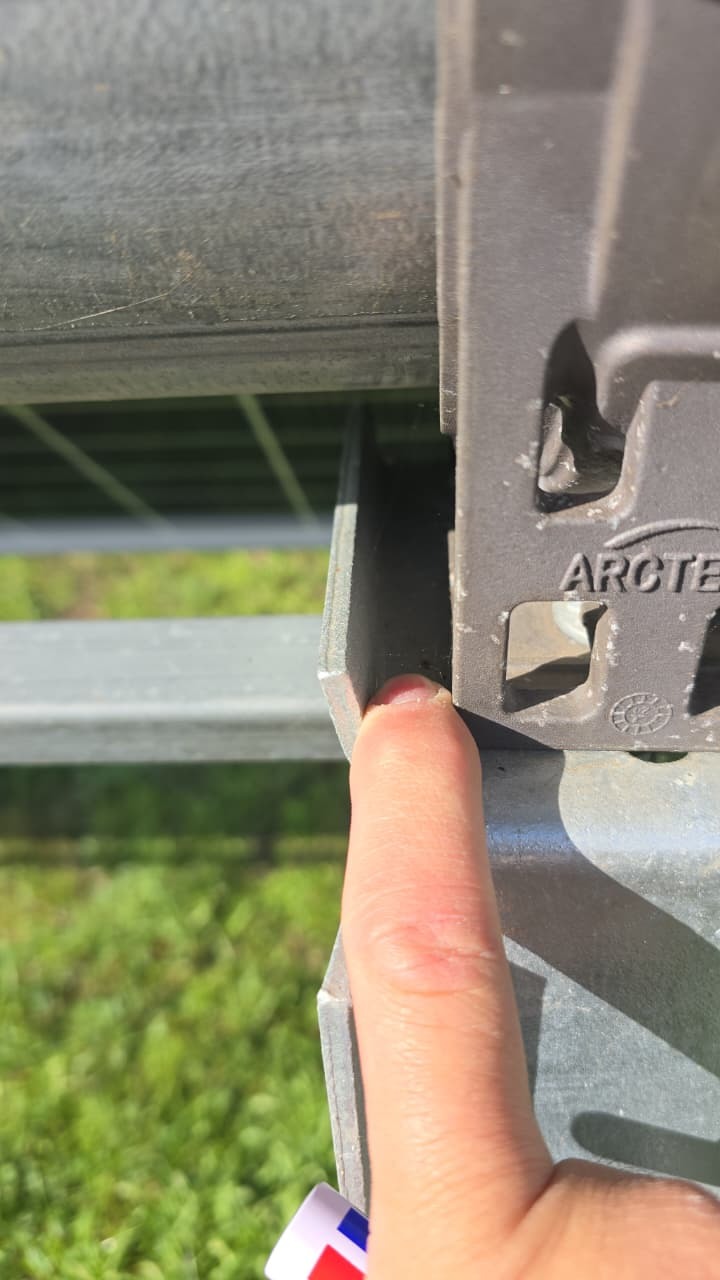
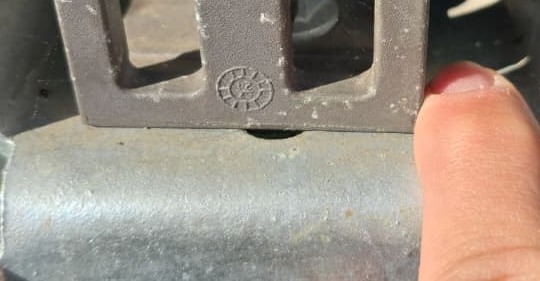
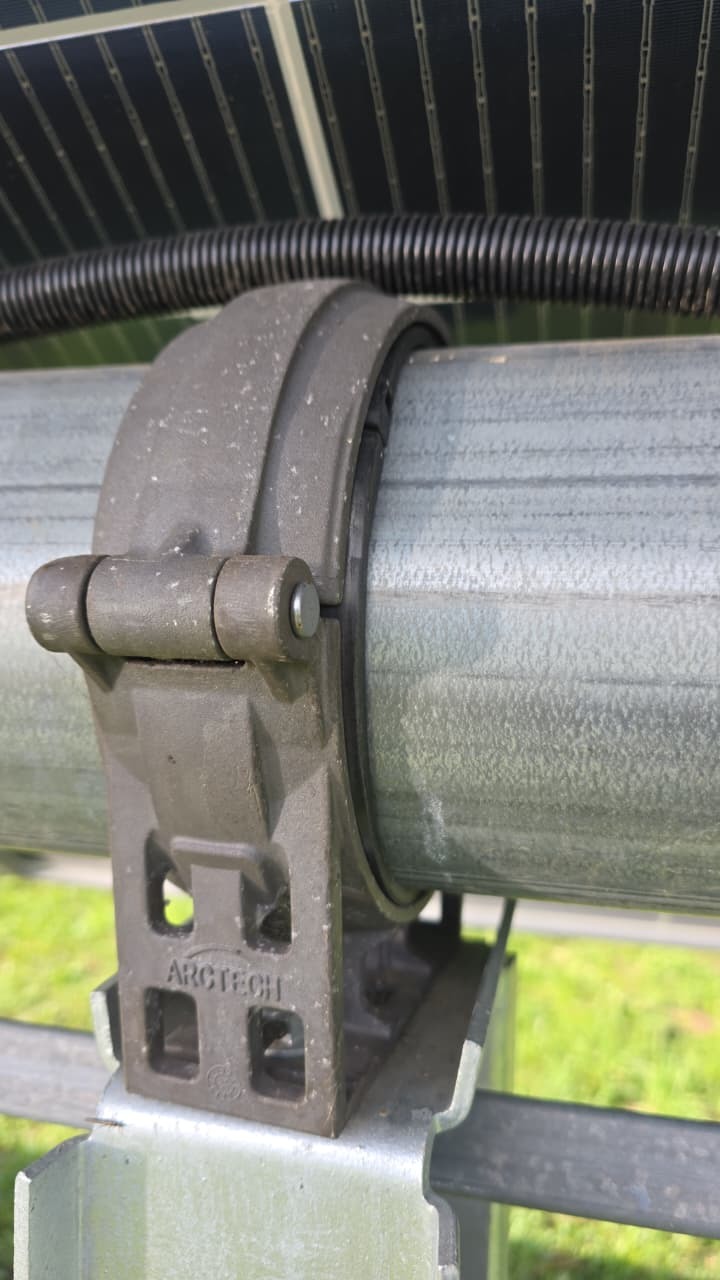
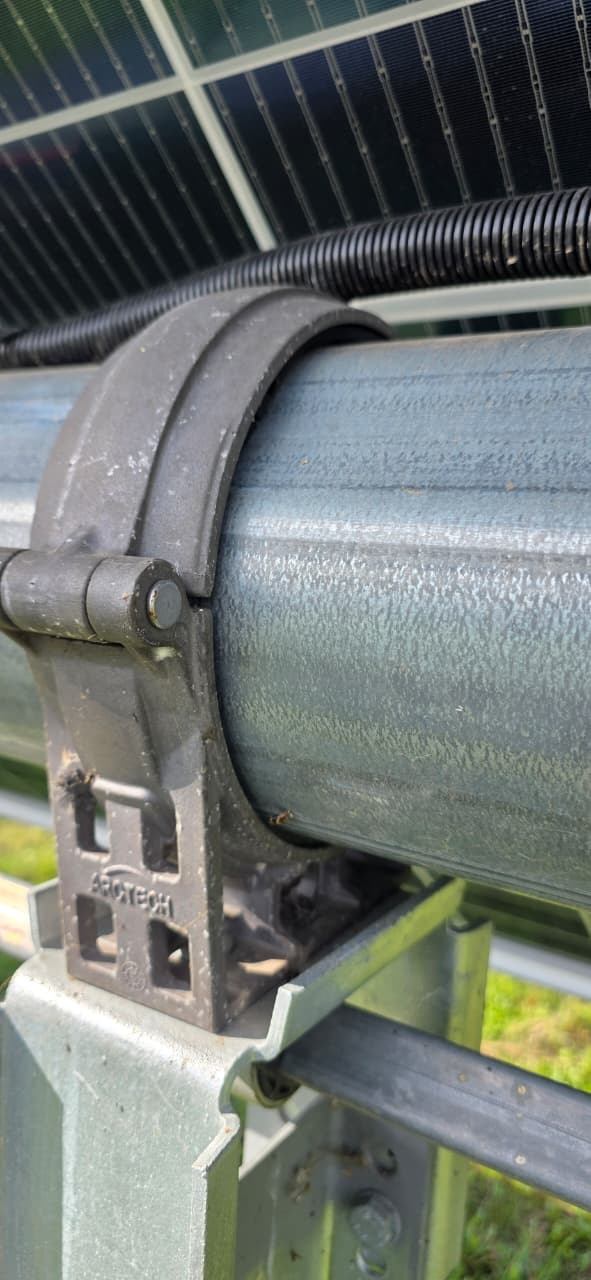
⭐ The plastic bearing against the housing — photographed 11 & 17 August 2026
Close-range inspections photographed the condition directly: the black plastic bearing has migrated along the torque tube and is pushed hard against the face of the bearing housing, with rubbing marks and a local loss of material at the contact. The free movement present at installation and at Arctech-signed commissioning is gone at the positions inspected.
⭐ The noise — measured 17 August 2026
Two videos were recorded at the bearing while the tracker was moving (16:27 and 17:42, different positions). Their soundtracks were analysed numerically.
| Metric | Aug A — 27 s | Aug B — 10 s |
|---|---|---|
| Discrete impulsive events | 48 | 19 |
| Event rate | 1.76 /s | 1.88 /s |
| Median interval between events | 0.54 s | 0.42 s |
| Energy 1–8 kHz (mechanical band) | 20–52% | 35–48% |
| Energy below 200 Hz (wind band) | 14.4% | 19.3% |
| Sustained crest factor | 17–26 dB | 20–26 dB |
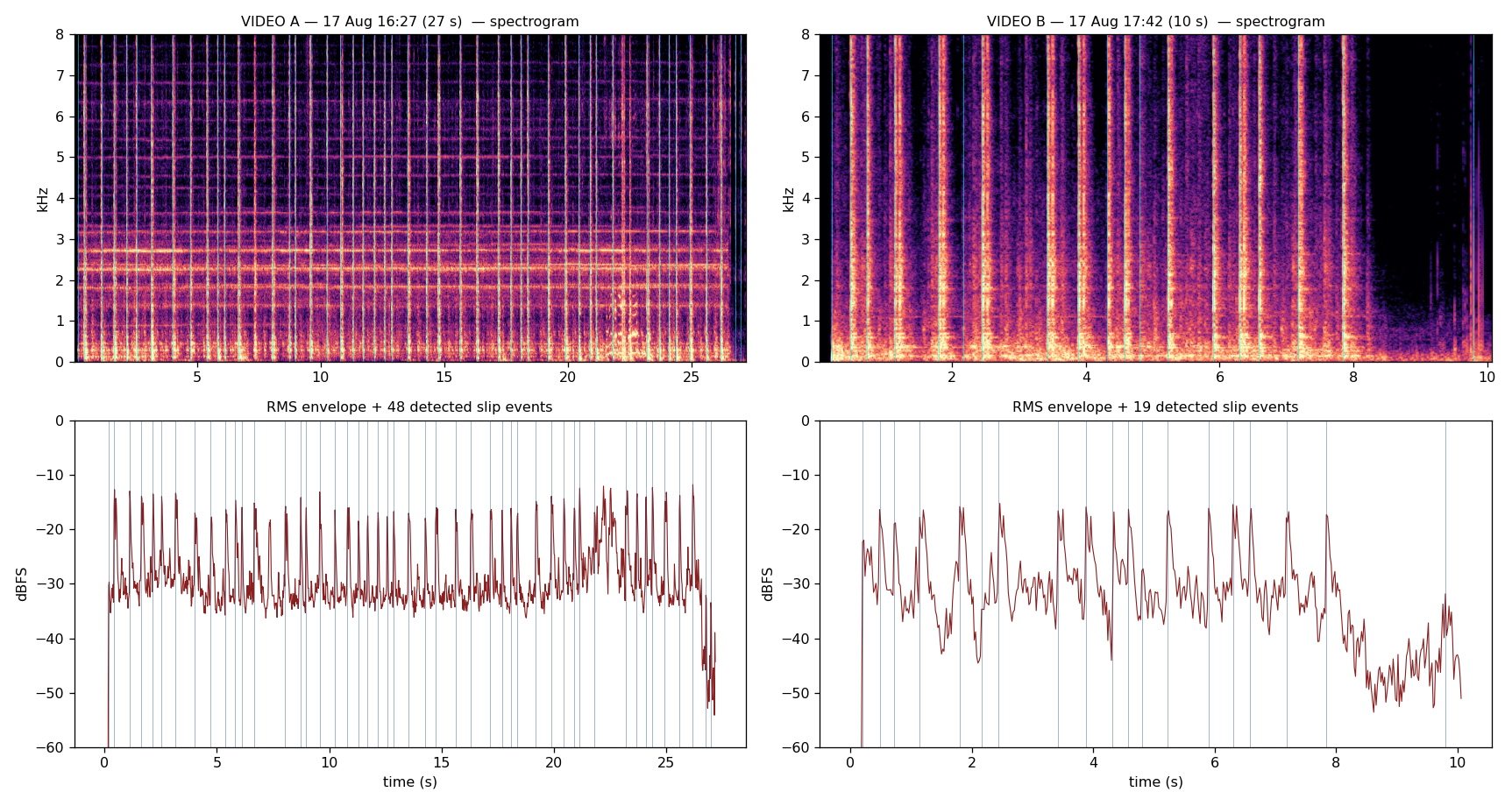
Why this is stick-slip and not wind, motor hum or ambient noise
- Repetitive broadband impulses — +8 to +18 dB steps within 20 ms across the whole 0–8 kHz band: sudden release of stored elastic energy, not a continuously driven source.
- A stable period. Two independent recordings, 75 minutes apart at different positions, both converge on ~1.8 events/second. Environmental noise does not hold a repetition period; a wind-up-and-release cycle does.
- Structural ringing at 2.3/2.7 kHz after each event — shock energy injected into the structure at every release.
- The noise is bound to the motion — it stops dead when the tracker stops.
Why it demands priority — the consequences for the machine
| Consequence | Mechanism |
|---|---|
| SAFETY Wind-stow reliability | The warranted wind stability presumes the tracker reaches stow on demand. A binding tracker may respond late, partially or not at all — in exactly the high-wind conditions where stow matters. Demand #1 asks Arctech's written position in 5 working days; protocol item 5 is a commanded stow-response test. |
| Drive-train overload | Breakaway torque exceeds design running torque; every ~0.5 s slip event shock-loads slew drive, gearbox and motor. The Owner asked for exactly this investigation on 29 Jan 2026; Arctech dismissed it as "no evidence". The evidence now exists. |
| Structural fatigue | Repeated torsional shock cycles the tube, welds and connections — including the rivet holes the retrofit itself drilled into the torque tube, each a stress concentrator in a torsion member, now in the load path of every slip event. |
| Accelerated bearing wear | 6.9 g mass loss in Arctech's own 28-day test — now running at field interfaces with sand, dust and water. Two housings had already re-failed by retrofit reception ("ambas sin remache"). |
| Tracking accuracy & production | Stepped motion and row misalignment degrade pointing (spec ≤2°) and yield; binding risks repeat stoppages of the kind already suffered (Angol 2025: ~1 week, ≈USD 500/day). |
Why Arctech's validation cannot close this
| # | Limitation of test CN25K8OP001 | Consequence |
|---|---|---|
| 1 | A single 10 m span between two columns — not a full-length tracker | Thermal movement scales with length. The dominant driver of the field failure was absent from the test by construction. |
| 2 | Bearing heated to 70 °C, but no representative tube thermal cycling and no imposed axial displacement | The exact load case that blocks the bearing was never applied. |
| 3 | No friction, torque or drive-current instrumentation — result is the observational "operated normally" | Stick-slip and rising breakaway torque would not have been captured even if present. |
| 4 | 6.9 g bearing mass loss (≈2.2%) recorded without comment | Confirms active abrasion → progressive, time-dependent degradation. |
| 5 | Tested by Arctech at Arctech's facility, spec "according to client's requirement", TÜV witnessing, result field "See Other" | A witnessed manufacturer test, not an independent certification of fitness for purpose. |
| 6 | Samples on the rig 8 Sep 2025 — a month before we reported failures; letter is a generic "Dear Customer" bulletin | The defect was known at fleet level with a remedy already in validation before disclosure to this portfolio. Both documents reached us only on 30 Jan 2026. |
What the claim asks for — 7 requests, no deadlines
| # | Request |
|---|---|
| 1 | Acknowledgement of the claim; open a formal warranty investigation |
| 2 | Arctech’s recommendation for interim operation of the affected trackers |
| 3 | Root-cause investigation into the displacement of the plastic bearing against the housing and the binding/knocking — as-built geometry, the manual’s bearing freedoms, condition of the rivet connections |
| 4 | Information on any revised bearing design or solution developed since the side-rivet solution (asked neutrally) |
| 5 | Joint site inspection, opening a sample of bearings on an agreed basis |
| 6 | As-built register of the 444 retrofitted positions by plant and tracker |
| 7 | Once root cause is established: permanent corrective solution at Arctech’s cost, with method statement and warranty on the works |
Reserved (unquantified): lost generation; wear/consequential damage to drives and structure; inspection and engineering costs; consequential damage to other plant equipment attributable to the abnormal operation. Removed by instruction: deadlines, wind-stow item, part-number item, motor-current item, all Owner-attributed content, and Los Sauces II (earlier bearing version, not retrofitted — not put forward for analysis).
The inspection protocol — designed to be falsifiable
Eight measurements, to be executed jointly with Arctech. The decisive one is item 6:
- Bearing position survey — axial position within seat, residual clearance each end, close-range photo with scale.
- Paired dawn/afternoon survey — same bearings at min and max daily tube temperature. Directly measures the thermal movement.
- Breakaway torque / drive current — retrofitted vs non-retrofitted through identical movement.
- Instrumented motion capture — calibrated audio + accelerometer on the tube through a full tracking cycle, extending the 17 Aug measurements.
- Stow-response test — commanded wind-stow on affected trackers; time-to-stow and completeness vs spec. The safety question, answered directly.
- Spatial correlation — binding/noisy/misaligned trackers mapped against the 444 retrofitted positions and terrain slope. Capable of disproving our own conclusion — included deliberately.
- Bearing removal and metrology — wear, ovality, mass vs nominal 318.3 g; inspect rivet holes in the tube for elongation or cracking.
- Row displacement survey — spacing along affected rows vs as-installed dimensions.
Documents
IEN-ARC-BRG-001 Rev. 05 — Technical Report · 6 pages, diagnostic framing, tracker-operation scope · the attachment to the claim email.
Open the report (PDF) Arctech Side-Rivets letter TÜV report CN25K8OP001Status
The claim email (Rev. 05 — diagnostic framing, no deadlines) is drafted in Zoho and not sent. Addressed to Octavio Caro, Alejandro Silva and Lucas Fernandes Sena; copied to Gerardo Castro, Sven, David, Jean Pozo and the Owner (Thomassen, Troncoso, Olivares) — Thomassen requested the claim and is aligned on the mechanism. The report PDF and the annexes (bearing photos 11 & 17 Aug + the two 17 Aug videos) must be attached manually. Annexes should contain only the bearing/tracker material — do not attach the May module survey.